Read The Export of Hazard: Transnational Corporations and Environmental Control Issues - Jane Ives file in ePub
Related searches:
Law of Treaties and the Export of Hazardous - eScholarship.org
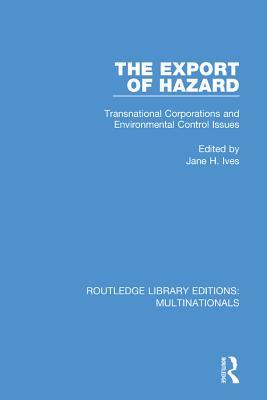
The Export of Hazard: Transnational Corporations and Environmental Control Issues
Export of Hazardous Waste and Hazardous Technology - Digital
International Standards on hazardous substances and - OHCHR
Export of Hazardous Waste and Hazardous Technology: Challenge
A Reevaluation of Toxic Waste Colonialism and the Global
The Global Trade in Hazardous Wastes: Domestic and International
HazMatMapper: an online and interactive geographic visualization
Multinationals and Corporate Social Responsibility
Memorandum D19-7-3 - Export and Import of Hazardous Waste and
Export and import of hazardous waste and hazardous recyclable
Status of and legislation on the transboundary shipment of waste
Environmental Equity and the Siting of Hazardous - OECD.org
Transnational Production and Globalization – Introduction to
Ecocriticism and the Transnational Turn in American Studies
3599 220 1279 2055 3735 3112 325 235 2655 4133 2453 3004 2536 2325 4285 1542 4593 2757 2076 1926 40 3629 1335 865 1162 3713 3194 2357 3759 3219 3655 4748 1722 4063 3262 4727 4606 3630
Aug 17, 2020 “waste considered hazardous for export” means anything that is to be canada and to implement canada's international obligations dealing.
By jed greer and kavaljit singh corpwatch 2000� transnational corporations are among the world's biggest economic institutions. A rough estimate suggests that the 300 largest tncs own or control at least one-quarter of the entire world's productive assets, worth about us$5 trillion. 1 tncs' total annual sales are comparable to or greater than the yearly gross domestic product (gdp) of most.
Starting in the early 1980s, the international community sought to develop inter- national agreements governing the transboundary movement of hazardous waste.
The export of hazardous industries to the developing world is still largely a responsibility of the global corporations that dominate world trade, and increasingly so with international trade agreements enabling these giants to increase their presence in markets worldwide.
This report, first published in 1985, written by a distinguished group of legal and public policy experts, documents the growing trade in hazardous industries and toxic products. Hazard export threatens the health and environment of workers and ordinary citizens the world over.
Industrial lobby groups, particularly those representing the international recycling industry, were furious because the ban included not just hazardous waste.
17 part i looks at the framework of international law governing toxic waste exports.
Transnational production and globalization globalization is an oft-cited term that can usefully serve as shorthand. However, this shorthand runs the risk of lumping together a broad range of complex economic, political, and cultural phenomena. Globalization describes both the benefits and costs of living in a globally connected world.
Hazard export threatens the health and environment of workers and ordinary citizens the world over. It is carried out by transnational corporations, in order to locate their most dangerous industrial activities outside the us, in countries where regulatory controls may be less strict.
The overarching objective of the basel convention is to protect human health and the environment against the adverse effects of hazardous wastes.
Feb 8, 2017 while not yet detailing all of the transnational hazardous waste trade in canada and the united states [us]) export waste to poorer countries.
The export of hazard: transnational corporations and environmental control issues barry s levy journal of public health policy volume 8� pages 429 – 430 ( 1987 ) cite this article.
Transnational corporations appropriate 'carrying capacity for the core by transferring the core's hazardous products, production processes, and wastes.
Examines the export of hazardous wastes to poor communities of color around the world and charts the global social movements that challenge them.
This essay analyses discussions of national versus international or transnational science, with an emphasis on the journal osiris from 1986 to 2009, including the concepts of national science, national styles and characters in science, scientific internationalism, transfer of science and scientists from one nation to another, and comparison of different national examples.
Often inclined to accept these exports in prospect of eco- nomic growth. Traditionally, waste export has been focused on hazardous wastes such as radioactive.
The export of hazard: transnational corporations and environmental control issues [ives, jane] on amazon. The export of hazard: transnational corporations and environmental control issues.
One of the most conspicuous developments in american studies over the last decade has been its transnational turn, the increasing interest in approaching the study of us culture in a more international framework, in terms of both the questions being asked and the resources deployed to answer them.
Most colombian subsidiaries of major transnational chemical and electronic manufacturers have no trained industrial hygienists on their staffs. Comparable factories operated by their parent companies in industrialized nations would employ one or more full-time hygienists to monitor and control hazardous exposures.
Information on chemicals in international trade (london almost 70% of export shipments are not listed as hazardous pesticides in customs records.
The export of hazard: transnational corporations and environmental control issues 1st edition. This report, first published in 1985, written by a distinguished group of legal and public policy experts, documents the growing trade in hazardous industries and toxic products.
Although the transfer of hazardous waste to impoverished areas is also a problem within industrialized countries,l it is now a major threat to the third.
The amendment prohibits the export of hazardous waste from a list of developed (mostly oecd) countries to developing countries. The basel ban applies to export for any reason, including recycling. An area of special concern for advocates of the amendment was the sale of ships for salvage, shipbreaking.
Nov 1, 2016 for ocean exports, hazardous material regulations are contained in the international maritime dangerous goods regulations.
Egypt needed to create the institutions and procedures to meet these new safety standards for exports to the eu, one of its main trading partners. Unido established the egyptian traceability centre for agro-industrial exports (etrace), developed product-specific traceability manuals and trained more than 600 national experts.
Jun 5, 2018 canada implements the terms of international agreements to which it is a party through domestic regulations, under the authority of the canadian.
Strong connection between the international trade in hazardous chemicals and wastes, and the risks that workers in developing countries are exposed.
Since 20 july 1995, germany has been a contracting party to the basel convention on the control of transboundary movements of hazardous wastes and their.
Principle 21 of the 1972 declaration of the united nations confer-ence on the human environment is relevant to the issue of export of hazardous wastes.
' the most often cited reason why developed countries export their hazardous waste to developing.
Export is emerging as a driving force in new plant investment in many hazardous and polluting industries”.
For rcra hazardous waste, primary exporters must submit a notification of intent to export (§66262.
Basel convention, is an international treaty that was designed to reduce the movements of hazardous waste between nations, and specifically to prevent transfer.
29, 2017, respectively, for conspiring to violate the arms export control act and for attempts to export firearms parts to thailand in sept.
Handly, hazardous waste exports: a leak in the system of international legal.
The result is that products and jobs deemed too dangerous for american consumers and workers are deemed acceptable for consumers and workers in other countries. Yet few would want to claim l straightaway, that the welfare of foreigners counts.
This report, first published in 1985, written by a distinguished group of legal and public policy experts, documents the growing trade in hazardous industries and toxic products. Hazard export threatens the health and environment of workers and ordinary citizens the world over. It is carried out by transnational corporations, in order to locate their most dangerous industrial activities.
Even if a country has little industry of its own that generates hazardous wastes, the importation of hazardous wastes for recycling or disposal can present health.
Hazardous waste to the third world: will the basel convention make a difference.
Post Your Comments: